
High Grade Gold Mining Claims Properties For Sale
Relevant Points Of Law
Various case law covering the finer points of mining claim ownership - rights
In law, the word "claim" in connection with the phrase "mining claim" perfected with a valid mineral discovery, represents a federally recognized right in real property.
The Supreme Court has established that a mining "claim" is not a claim in the ordinary sense of the word a mere assertion of a right, but rather, is a property interest, which is itself real property in every sense, and not merely an assertion of a right to a property.
A (unpatented) mining claim has been "perfected" where, assuming the performance of the requisite acts of location and recordation, a discovery of a valuable mineral deposit has been made within the physical limits of the claim. See, e.g., United States v. Mavros, 122 IBLA 297, 301-302 (1992); United States v. Nickol, 9 IBLA 117, 122 (1973); Clear Gravel Enterprises, Inc., A-27967 (Dec. 29, 1959).
"When the location of a mining claim is "perfected" under the law, it has the effect of a grant by the United States of the right of present and exclusive possession. The claim is property in the fullest sense of that term; and may be sold, transferred, mortgaged, and inherited without infringing any right or title of the United States. The right of the owner is taxable by the state; and is "real property", subject to the lien of a judgment recovered against the owner in a state or territorial court. The owner is not required to purchase the claim or secure patent from the United States; but so long as he complies with the provisions of the mining laws his possessory right, for all practical purposes of ownership, is as good as though secured by patent." Wilbur v. U.S. ex rel. Krushnic, 1930, 50 S.Ct. 103, 280 U.S. 306, 74 L.Ed. 445.
The claimant has the exclusive right to possession and enjoyment of all the surface included within the lines of the locations, but the United States retains title to the land. 30 U.S.C. § 26, 35; Union Oil Co. of California v. Smith, 249 U.S. 337, 349 (1919); Wilbur v. U.S. ex rel. Krushnic, 1930, 50 S.Ct. 103, 280 U.S. 306, 74 L.Ed. 445; California Coastal Comm'n v. Granite Rock Co., 480 U.S. 572, 575, 107 S.Ct. 1419, 1422, 94 L.Ed. 2d 577 (1987); Swanson v. Babbitt, 3 F.3d 1348, 1350 (9th Cir. 1993).
"Under the mining laws a person has a statutory right, consistent with Departmental regulations, to go upon the open (unappropriated and unreserved) Federal lands for the purpose of mineral prospecting, exploration, development, extraction and other uses reasonably incident thereto." (See 30 U.S.C. § 21-54, 43 C.F.R. § 3809.3-3, 0-6).
There is no question that reasonable access to a valid mining claim cannot be denied. 36 C.F.R. § 228.12; see United States v. James and Marjorie Collard, 128 IBLA 266, 291 (1994). 16 U.S.C. § 481, Use of Waters: All waters within boundaries of national forests may be used for domestic, mining, milling, or irrigation purposes under the laws of the state wherein such national forests are situated or under the laws of the United States and the rules and regulations established thereunder.
The discovery of a valuable mineral deposit within its limits validates a mining claim located on public land in conformance with the statute and its locator acquires an exclusive possessory interest (valid existing private property rights) in the claim; a form of real property which can be sold, transferred, mortgaged, or inherited, without infringing the paramount title of the United States. 30 U.S.C. § 26; Cole v. Ralph, 252 U.S. 286, 295 (1920); Forbes v. Gracey, 94 U.S. 762, 767 (1877).
If a discovery of a "valuable mineral deposit" is made, the mining claim can be held indefinitely so long as the annual assessment work is performed, the necessary filings are made, fees are paid, and a valuable mineral deposit continues to exist. See Best v. Humboldt Placer Mining Co., 371 U.S. 334, 336, 83 S.Ct. 379, 382, 9 L.Ed. 2d 350 (1963).
30 U.S.C. § 26 addresses the "locators' rights of possession and enjoyment" as follows: "The locators of all mining locations on the public domain so long as they comply with the laws of the United States, and with State and local regulations not in conflict with the laws of the United States governing their possessory title, shall have the exclusive right of possession and enjoyment of all the surface included within the lines of their locations."

Situated in the middle of 3 major wilderness areas...
Separated from the Redwoods only by the coastal range...
Vast beauty, Lesser-traveled, Adventure, Excitement...
Extreme Northern California's Gold Rich Salmon River Region
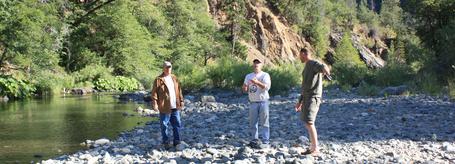
It's a wild place to explore

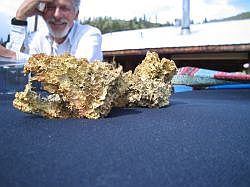
The gold mining claims we offer for sale are guaranteed to contain paying quantities of gold.
They have never been worked over by any clubs or worked in excess by any modern mining methods. They have never been mined by us beyond routine sampling and assessment work, always ensuring intact, uncompromised values. If it's quality you seek, contact us when you're ready to own a gold mining claim property.
The Claim Post... representing the finest in gold mining claims property listings.
High-grade gold mining claims properties for sale.
Liberty & Salmon River Mining Districts. Siskiyou County, CA
We are a company with more than 40-years experience in the gold mining industry who have predominantly focused our attention and gold recovery labors in this region.
While taking in to account what has been documented by state and federal agencies, historians, geologists, scientists, & by way of our own experience, we believe this area represents an incredible opportunity for recovering mass quantities of gold within proven gold producing trends that boast phenomenal records of gold production history.
We invite you to consider the few gold mining claim properties we are offering for sale in this region.
Contact Us!
T: 303-827-3311
The Claim Post. High Grade Gold Mining Claims Properties For Sale. © Copyright 2003 to present. All rights reserved.



...the most trusted name in gold property listings.
est. 2003
The Claim Post
World-Class gold properties for sale









This Is Gold Country!
\